The Parlour Game Before the Party Game
Parlour games turned an ordinary visit into a shared evening. Learn how these homegrown pastimes worked, what set them apart, and why their history matters.
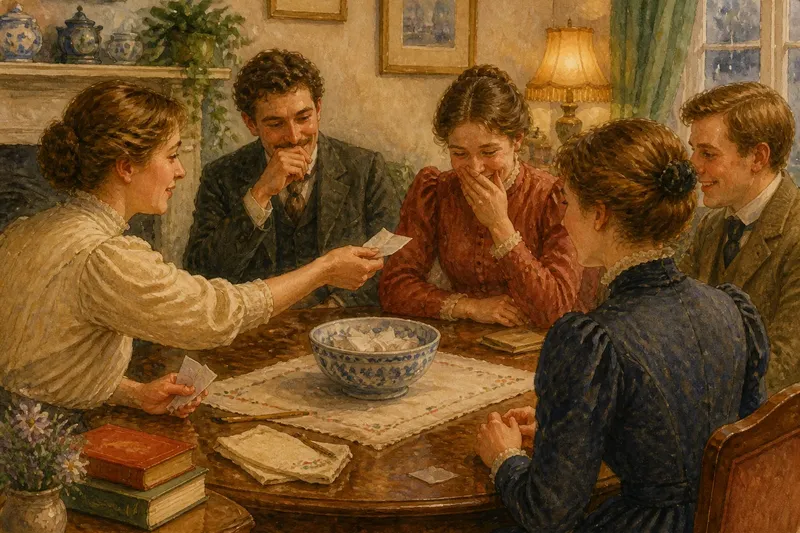
A folded note passes from hand to hand as someone tries not to laugh. Parlour games like this made home visits lively without needing a stage, special equipment, or a formal program. Their history is not a single straight line from an old pastime to the boxed party games sold today; it is a varied story of people adapting play to a room, a gathering, and whatever they had nearby.
That domestic setting is the useful distinction. A parlour game was shaped for play among visitors at home, but the label covers many kinds of pastimes rather than one fixed set of rules. Looking at the room, materials, and social customs around these games makes their appeal easier to understand without treating every household as if it followed the same tradition.
Parlour games belonged to the household setting
The word “parlour” points to a room used for receiving visitors. In that setting, people might sit around a table, form a circle, or take turns speaking from their chairs. The room set practical limits: a game needed to suit the available space and the company present.
It is safer to describe parlour games as a broad family of home pastimes than to draw a firm boundary between play and performance. Some involved speaking or acting for others; many also invited the group to respond, guess, or take a turn. The distinction depended on the particular game and gathering, not simply on whether someone was being watched.
Imagine friends arriving on a rainy evening and settling into a sitting room. One suggests a word game using slips of paper and a bowl. The expected result is a modest change in the room’s rhythm: people take turns offering clues, then talk about the guesses and the surprises.
Simple materials made different games possible
Paper, cards, a handkerchief, a household object, or a spoken phrase could all serve as a starting point. Some games needed no materials at all. These details mattered because they let hosts choose a pastime that suited the room instead of arranging the whole gathering around equipment.
A deck of cards can support games with different degrees of competition and concentration. A spoken word game can begin without anyone fetching supplies. Materials did not define the tradition; they were practical tools that varied from game to game.
That variety also cautions against imagining one standard parlour-game kit or one universal set of rules. A host might teach a familiar game from memory, adapt a prompt, or explain a pastime to newcomers. The exact version could depend on who was present and what they already knew.
Rules shaped how a gathering took turns
A concise rule could help a group begin, especially when some guests were unfamiliar with one another. A clear turn-taking pattern made it easier to follow what was happening. It did not mean every player had to contribute in the same way or at the same pace.
Different games called for different kinds of attention. A guessing game might reward a carefully chosen clue; a storytelling pastime might depend on each player adding a phrase. In either case, the rule gave the activity a recognizable shape, while the players supplied its particular character.
For a host choosing a game, these practical checks can help match the pastime to the gathering:
- Check whether the rule can be explained in a few spoken sentences; if it can, introduce it directly, but if it needs a long explanation, choose a simpler game or demonstrate one turn.
- Check whether players know when their turns begin; if the order is clear, start the round, but if people are unsure, set a visible order such as going around the table.
- Check whether someone can observe or pass without disrupting play; if so, say that this is an option, but if not, choose a game with a less demanding way to take part.
- Check whether the game depends on reading, writing, quick recall, or movement; if those demands suit the group, keep the format, but if not, switch to a version that does not rely on the difficult task.
- Check whether scorekeeping is part of the fun for this group; if players enjoy it, track points on paper, but if it distracts from the gathering, use a game with no winner.
- Check whether the needed materials are already available; if they are, set them out, but if they are not, choose a spoken game or substitute an ordinary object that fits the rule.
Familiar play could become a household custom
When people remembered a game and chose to return to it, it could become part of a household’s way of receiving visitors. The tradition did not need to be formal. Someone might keep pencils handy, explain the rules, or suggest a game after a meal.
Those habits varied. A game remembered in one family might be unfamiliar in another, and a pastime could change as people adapted it. Rather than assuming a single shared custom, it is more accurate to see repetition as one way a group made a particular game its own.
That small ritual could mark a shift in the visit. Plates were cleared, chairs turned toward one another, and someone asked who remembered the rules. The game offered a next activity without requiring a formal schedule.
Parlour games and party games overlap without being identical
“Party game” is a broad label for activities used at social gatherings. “Parlour game” points more specifically to domestic group play, though the categories overlap and their meanings can vary. Some familiar party games resemble older home pastimes in their use of simple rules, spoken prompts, and turns.
Format alone does not tell the whole story. A game in a box may make its rules and materials easy to find; a game passed along by memory may be adapted more freely. Neither description establishes which version is older or better. The useful question is whether a particular game fits the people and setting.
Say a host has paper, pencils, and a group of neighbors who enjoy wordplay but do not want a score. The host writes one familiar object on each slip, folds the slips into a bowl, and explains that players take turns giving clues while the group guesses. If a guest prefers not to give a clue, the host offers the option to draw again; the resulting game keeps a clear turn order without making competition its center.
What do readers ask about parlour games?
What is a parlour game?
A parlour game is a pastime played in a domestic social setting, often with simple materials or none at all. The term covers varied activities rather than one universal collection of games.
How is a parlour game different from a party game?
The terms overlap, but “parlour game” emphasizes home-based group play, while “party game” can describe activities in many social settings. A particular game may reasonably fit both descriptions.
Did parlour games always have a winner?
No single format defines the whole category. Some games use points or declare a winner, while others center on guessing, storytelling, or shared amusement without keeping score.
How can a host teach an unfamiliar parlour game?
Explain the aim and the first turn, then demonstrate if seeing the action is clearer than hearing the rule. Let guests watch or pass so joining does not depend on performing immediately.
The history is clearest when each game keeps its own context
Parlour games are best understood as varied home pastimes, not as a single uniform tradition with one origin or one set of customs. Their materials, rules, and social roles could differ from one gathering to another. Keeping that variety in view makes their history more grounded and less likely to turn a familiar label into an unsupported claim.
For a countryside weekend, the historical idea can be useful without trying to recreate an imagined past. Choose a game whose materials and demands fit the people in the room, explain how it works, and let its particular rules set the pace. The details of each pastime—not a sweeping story about all parlour games—are what give an evening its character.